


So months of speculation about the sale of WBD have finally ended. Some commentators are spelling the end of Hollywood as a result, others are more congratulatory saying that finally there is a traditionally based media group that can take on the tech-bros from San Fran.
However, there are two things that strangely people arent talking about - compatibility and discoverability. When two organisations with utterly different cultures collide, the result is never just a bigger catalogue. It’s an identity crisis waiting to happen. I know because I’ve lived in these cultures and I’ve also lived through consolidation when I was at LWT - which became first Granada before becoming ITV. My time at Discovery and National Geographic taught me about how giant American organisations worked and I can tell you these two beasts may, to the outsider, seem the same but their ethos’s are definitely not.
I have never worked at Netflix but I know plenty of people who do (or did) and one thing I can takeaway from that organisation is that they operate at a velocity that Discovery could never have imagined. These are two organisations that are In fact worlds apart. They may make content, but thats where the similarities end. They maybe neighbours on your smart TV’s menu but in reality they’re different planets entirely and when one planet is much larger than the other, gravity becomes a problem.
Despite this, the real story isn’t scale - scale is a commodity now. The real story is discoverability, identity and the uncomfortable fact that the bigger you get, the harder it becomes to know who you are. The platforms think size guarantees survival, that scale means they’re too big to fail. In reality, size is the enemy of taste. And taste is the only thing audiences actually trust. I think the next decade will be shaped not by who owns the most, but by who still feels like something in a world where everything looks the same.
The Illusion of Infinite Choice
There’s a paradox our industry refuses to confront. Human beings think they want endless choice, but in reality we crumble under it. Who amongst us hasn’t spent at least 30mins endlessly scrolling for something to watch on various platforms? Netflix already offers more content than anyone could meaningfully navigate, displaying only a tiny fraction of its inventory to us and now it is hoovering up the most prestigious catalogue of the last century.
Does that sound like a good idea to you as the consumer? Were you sitting in front of Netflix saying “Damn! I wish there was more to watch on here I’ve seen everything they have to offer…”No. So a combined Netflix WBD library isn’t abundance it’s just a fog and when the fog rolls in, audiences cling to whatever is easiest to find. This is why discoverability has become the core strategic battle of the streaming era. If a viewer can’t see you, you’re dead. It doesn’t matter how good your show is. It matters whether it surfaces. And in a world ruled by algorithmic inertia, most things don’t.
This merger risks turning a library into a landfill. The shiny titles rise to the top because they’ve been engineered to, while the quieter, stranger, more inventive series sink into the sludge. This is why recently the BBC has been arguing that they need to have laws to ensure their content is placed high on platforms like YouTube - they know that even their expensive content will drowned out by American funded programming. I mean they commission so much stuff that even they have problems surfacing content on their own platforms meaningfully - so imagine whats its going to be like when you own the biggest library on earth.
It’s a deep irony, we keep making more, yet fewer people watch because things are actually no longer discoverable. Too much content is beginning to resemble too much noise.
What The Clash Taught Us
There is a useful analogy here, immortalised to me by the cult British punk band, The Clash. Their song “Lost in a Supermarket” perfectly depicts what happens when consumerism takes over in an industry - it causes a broader cultural flattening, the beginning of a world where everything is packaged, branded, optimised, and drained of soul. If they’re not careful, the mega supermarket offering of content that Netflix will become could cause it to be a cathedral devoid of any higher being. So far from this merger being the end of Hollywood, it could in fact mark the beginning of a new dawn.
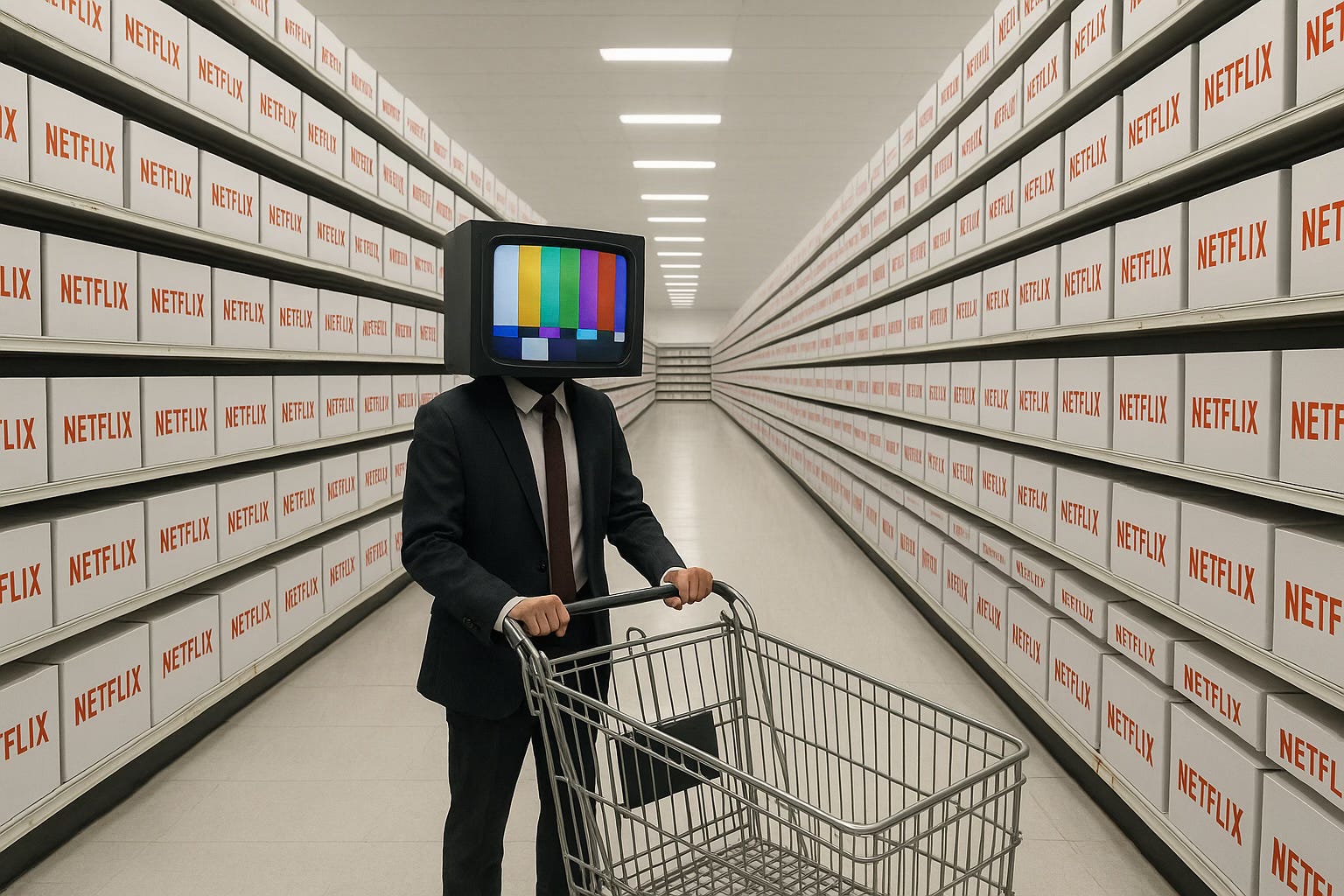
People love to say that supermarkets killed the small shop. They didn’t. They killed the small shop pretending to be a supermarket. The butcher survived. The baker survived. The fishmonger survived. The people offering a weaker version of what Tesco could do better did not. That distinction matters. You cannot out-Tesco Tesco, and you cannot out-Netflix Netflix. Anyone trying to behave like a generalist in an age where the generalist slot has been definitively claimed is signing their own death warrant.
What survived were the specialists. The places with personality, expertise and soul. The shops that still smelled of something distinctive when you walked in. And increasingly, that is exactly what audiences want from content brands. Not volume. Not scale. Just character.
I love a wee dram…
Talking of character Whisky might be the clearest analogy for what content must become. You can buy a bottle in a supermarket for convenience. You can order a dram in a pub for sociability. You can taste a twelve-year single malt in a cocktail bar because you’re in the mood to feel fancy. Or you can visit the distillery itself and immerse yourself in the craft. The liquid doesn’t change. The price does and the experience changes everything. You might not like whisky so don’t buy it. But I can tell you, some of those distilleries, despite being owned by massive parent companies, still turns over some pretty giant numbers in a literal sea of alcohol.
This is precisely how premium content behaves. Sadly, as a result of this merger we might all find that a Netflix–WBD subscription may well become a bit more expensive - I mean they’re going to need to repay that $80 BILLION + somehow, But ask yourselves this. Didnt we all just “cut the cord” because we all wanted to choose our own content? Didnt we want to cherry pick a channel here, a channel there? Isnt that’s the reason that we hated the homogenised bundle of cable - there was too much crap we just didnt want and hated the thought of paying for. I think thats whats going to happen with Netflix - I don’t want TONS of content, I want their carefully curated originals. Their sports docs, their crime specials, the content that makes you see the world in a different way. Do I want Shark Week? Nope.
This is the point, the premium brands, the distilleries in this metaphor, become more valuable precisely because they are not for everyone. What they sell is not quantity. It is meaning and people will always pay more for meaning.
Culture Clash
Now let’s talk about culture, because it is the most overlooked consequence of this merger. Discovery and Netflix do not share a history, a rhythm or a worldview. Discovery built itself on craftsmanship, tight budgets, big characters and the strange beauty of the real world. Netflix built itself on velocity, scale and ambition bordering on mania. One is a long-form documentary maker with a love of real people. The other is a tech company wearing the skin of a studio.
Put those two together and you don’t get harmony. You get dilution. Once the WBD catalogue is absorbed into the Netflix machine, the identity of both will weaken. It’s inevitable. That’s what happens when you cram too many signals into one system. The BBC feels like something. ITV feels like something. Apple feels like something. A gigantified Netflix risks feeling like nothing at all.
We forget that culture is not an output. Culture is the thing that shapes the output. And if the culture becomes a messy blend of incompatible instincts, the work will follow. Zaslav never got this, I thought Sarandos did. However, I guess in the end, the plans for world domination always corrupt even the best intentions.
Techbros at the Gates
Maybe I’m being harsh. We’re also living through a moment where media is desperately trying to behave like tech because tech valuations are the only valuations worth having. This is why the platforms keep consolidating. Not for creativity. Not for craft. For share price. For investor mood music. For the kind of one-generation wealth creation you only get when a CEO believes scale itself is the product.
But it’s definitely true to say that tech doesn’t care about culture. Tech cares about leverage. Tech cares about data. Tech cares about absorption. So the irony is that Netflix, in all its power, may eventually become the thing it once disrupted: a resource to be bought and scraped by an even bigger player. Whether that’s OpenAI or someone else, the direction of travel is obvious. The mega-corporations will eat everything. It’s the only playbook they know.
The Future Belongs to the Distilleries
And yet, despite all of this, the creative economy will live on. It always does. Not in the skyscrapers. Not in the mega-consolidated platforms. It lives on in the places with identity, soul and stubbornness. It lives on in the artisanal bakeries of storytelling, the distilleries of character, the creators who know exactly who they are and refuse to be mistaken for anything else.
The giants will merge, swell, wobble and eventually topple into the arms of tech. Meanwhile the distilleries, the content shops with a smell, a texture, a point of view will keep producing work with meaning. Until, of course, someone buys them too. That’s the cycle. But between now and then, craft always finds a way to breathe.
Scale will win battles, yes, but I truly believe identity will win the war. The future will belong to those who stand for something in a world determined to flatten everything into the same beige paste. For all the noise around the Netflix–WBD merger, the opportunity for the rest of us has never been clearer. Don’t try to be the supermarket. Be the distillery. Be the whisky people remember. Be the thing that cuts through the fog.
Nice piece Ed. I’d concur with “The real story is discoverability, identity and the uncomfortable fact that the bigger you get, the harder it becomes to know who you are”.
But “scale is a commodity now.”?