


TV is about as collaborative as two opposing magnets. Everyone claims they’re all for it, right up until you try to push two organisations together and the whole thing starts skittering across the table like a badly behaved toddler being told to share the crayons.
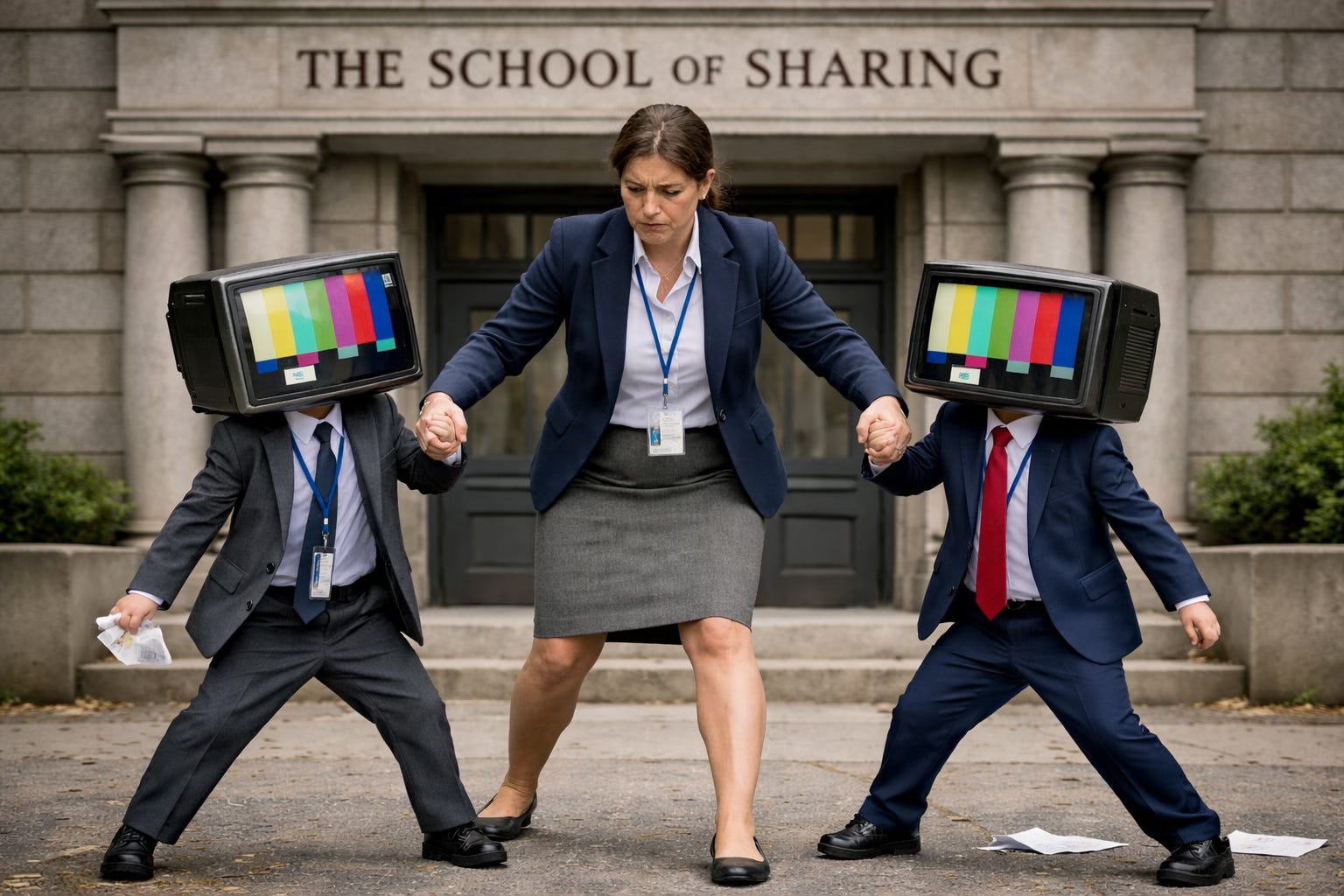
The maddening bit is that I’m not even arguing about anything particularly romantic. I’m arguing about basic commercial sense in a market where distribution has narrowed, marketing has become harder, and discoverability is now the real currency. Yet we still behave as if the only way to prove you value a show is to lock it in a cupboard for eighteen months and act shocked when nobody’s talking about it by the time you let it back out.
But let’s rewind for a second. Old-school exclusivity was built for a world of scarcity. Five channels. One time slot. One audience. Getting the eyeballs was everything. Miss the slot and it was trade-news worthy. Exclusivity wasn’t a tactic, it was the game. Own the biggest movie, the biggest sporting event, or the only access to the biggest story of the day. If your channel didn’t have exclusivity, you were on a road to nowhere.
That logic made sense when audiences were linear, marketing was blunt, and discovery meant a Radio Times listing or a splash in the tabloids. But that world has gone. Audiences have fractured, attention has thinned, and discoverability has become the single hardest problem in the business, even for the streamers. Just think about how much content exists, versus how little of it any one of us actually watches.
Strangely, television has yet to adapt in the way other industries have for decades. Food, retail, publishing all worked this out long ago. In a world where every channel’s distribution has narrowed, TV still behaves as if locking something away is the same as valuing it. Imagine if Oxo only sold stock cubes through the Co-op, or Ralph Lauren was only available in its own boutique stores. They’d be a fraction of the businesses they are today.
What we’ve ended up with is a system that damages almost everyone involved. Producers are forced into artificial windows that kill momentum. Channels overpay for exclusivity that no longer delivers proportional value. Audiences struggle to find things they would love because the trail has been deliberately obscured in a world of noise and choice. Credits are buried or skipped entirely, making it harder for creators to build reputations and for channels to accrue long-term brand equity.
The irony is that digital has already moved on. Progressive deals, shared visibility, open attribution and algorithm-friendly crediting are now basic hygiene online. Television, meanwhile, is still being run by people steeped in traditional lore, but unable or unwilling to take the steps needed to drag the industry into its next phase.
The myth of protection
Exclusivity is usually justified as protection. Protecting brand. Protecting spend. Protecting perceived value. In practice, most modern TV exclusivity does the opposite. It shrinks the potential audience, shortens the life of a show and forces marketing to work far harder than it should. Just how many subscriptions to small, niche channels can any of us realistically afford?
A factual series can cost hundreds of thousands to make, yet we deliberately constrain where and how it can be seen because discovery is limited to the originator’s channel, usually behind a paywall. This tends to come from desperation rather than strategy. Channels are hunting for a hit, something that will magically reverse declining reach and bring audiences flooding back. But that’s not how it works anymore.
Instead, we insist on long, aggressive holdbacks that kill word of mouth just as it’s starting. We treat secondary windows as dilution rather than amplification. Then we complain that shows don’t travel, don’t land culturally, or don’t build any kind of momentum beyond their initial run.
Of course there is sense in having a unique home for a big brand. If you create the next Downton Abbey, you are quids in as a producer and as a channel. But that is the exception, not the rule, and I’m not convinced it could even happen today behind a narrow paywall. Even the next Game of Thrones has struggled sitting inside a closed ecosystem during a cost of living crisis. Most projects simply won’t become juggernauts unless the platform they sit on has real, meaningful reach.
What linear channels actually want is simpler. They want their content to be seen, and crucially, to be recognised as the place that created it. The unspoken assumption is that if you like this, you’ll come and find us.
That assumption holds for very large platforms with scale. It breaks down fast for smaller channels. They need different tactics. Yes, be the home. Yes, take the premiere. But then move quickly to ensure that other platforms, even in the same market, can carry the show once that initial run has done its job.
It takes a brave broadcaster to think like that. But that’s exactly what Sky History did when they commissioned Battle Treasures. Within months, the entire first series will be available on my Amazing War Stories YouTube channel. That’s a win for my company, and I’d argue a win for Sky History too.
But would that same thinking stretch to sharing with a terrestrial channel? I’m not so sure.
Digital collaboration exists. Linear pretends it doesn’t.
Setting my own deal aside, here’s the really strange part. This kind of collaboration already happens. Just not where it’s needed.
Digitally, broadcasters have been quietly doing progressive, brand-safe sharing deals for years. ITV and Disney now surface each other’s shows on their platforms, clearly branded, clearly attributed, and without anyone panicking about loss of identity. Netflix carries a significant amount of BBC content, proudly badged as such. Nobody is confused. Nobody thinks the BBC has disappeared or that Netflix has somehow weakened itself by sharing the shelf.
In fact, the opposite happens. Brands travel. Audiences learn where things come from. Curiosity is sparked rather than suppressed.
So why does this logic evaporate the moment we talk about linear television? Why is it perfectly acceptable on a streaming homepage, but apparently heretical on an EPG? Audience behaviour hasn’t changed. Branding principles haven’t changed. The commercial upside certainly hasn’t changed. Only the mindset has.
Linear still behaves as if visibility is something to ration rather than maximise. It treats shared branding as dilution, even though digital has repeatedly proven it to be amplification.
The usual counter-argument I hear from old-school execs is, “How would viewers know they’re watching our content if it’s on someone else’s channel?” The answer is disarmingly simple. Put your name on it. Properly. At the front. When you buy a jumper from a department store it doesn’t say the stores name on it but the manufacture’s label. It would be akin to the shops asking that the clothing labels were cut off before they could sell them.
Credits are not vanity, they are infrastructure
This isn’t accidental. The film industry and high-end drama front-load credits all the time, and they do it for a reason. Billing matters. It’s contractual, cultural and commercial. Studios understand that attribution is part of the asset, not decoration for the end once everyone’s picked up their phone.
Every major film opens with a studio identity. A logo. A statement of origin. You immediately know whether you’re watching something from Paramount, Warner Bros or Universal. That branding travels everywhere the film goes. Cinema, streaming, airline edit, late-night TV. Nobody thinks this dilutes the movie. It reinforces where it came from and who backed it.
Drama works exactly the same way. Creator names sit up front. Writers, producers and directors are clearly signposted. That isn’t indulgence. It’s how reputations are built, how audiences learn to trust voices, and how commissioners learn who can actually deliver. Credit builds careers. Careers build trust. Trust builds value.
Unscripted somehow decided it didn’t need this discipline. Credits were pushed to the back, squeezed, rushed or skipped entirely, as if speed mattered more than identity. In doing so, factual didn’t just hide its talent, it erased its origins. Shows began to float free of the channels that created them, stripped of context, provenance and long-term brand value.
And this is the crucial point. Credits aren’t just about people. They’re about who originated the content. If films can proudly open with a studio logo wherever they play, why does television shy away from the same principle? Why shouldn’t a factual series carry an originator credit wherever it appears?
A simple “presents” at the front does an enormous amount of work. It tells the audience where the idea was born. It creates a trail back to the commissioning channel. It allows shows to travel without pretending they appeared out of thin air. That isn’t giving something away. It’s staking a claim.
In a world where discoverability is scarce and loyalty is fragile, removing origin branding isn’t neutral. It’s self-sabotage. If you want audiences to follow you, you have to tell them who you are, every single time.
Discoverability is the real currency
We talk endlessly about budgets, rights and windows, but the real battle is being fought elsewhere. Discoverability is now the scarcest resource in the system. If audiences can’t find you, nothing else matters.
Exclusivity once functioned as a discovery tool. “Only on” meant something. In a world of infinite choice, it rarely does. What cuts through now is repetition, reinforcement and cross-pollination. Seeing something in more than one place isn’t confusing, it’s reassuring. It signals quality. It suggests momentum.
Digital creators understand this instinctively. They collaborate, cross-post, credit obsessively and build networks of mutual amplification. Television still behaves as if collaboration is weakness rather than strategy.
All boats really do rise when the tide comes in, but only if we stop chaining them to the dock. We have to allow audiences to encounter brands in as many places as possible. If they like what they see, they’ll know exactly where to go for more, provided we’ve signposted it properly.
A bit more sharing, and frankly a bit more confidence in your own brand, would do wonders for viewing figures. And believe me, the commercial channels need all the help they can get.
Who is really holding this back?
It would be comforting to blame contracts or lawyers, but the truth is simpler and less flattering. The industry is still dominated by people whose formative experiences belong to a different era.
They grew up in a world where control equalled power. Where letting go felt dangerous. Where sharing credit meant losing status. The next phase of television requires the opposite instincts. Openness. Attribution. Confidence in origin rather than fear of leakage.
This isn’t about being nice. It’s about being competitive.
Television doesn’t need more exclusivity. It needs more shared success. The shows that survive the next decade won’t be the ones locked away most tightly. They’ll be the ones that were seen, credited and talked about everywhere.
If sharing makes you uncomfortable, good. Discomfort is usually the first sign that the ground has already shifted.